MANIFESTO OF NODS
NODS — Short Manifesto
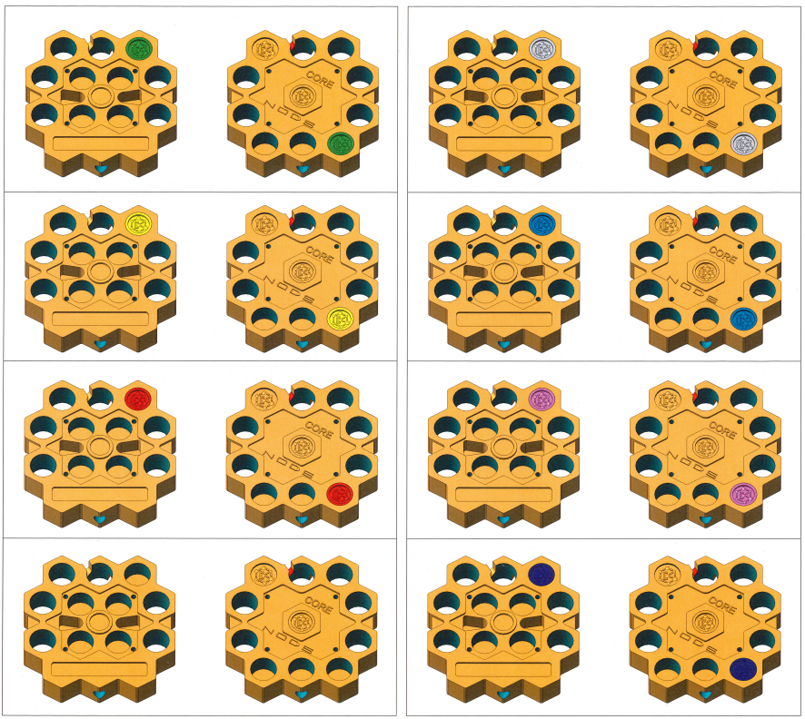
NODS is a physical collectible system.
It is not a game. It is not an investment.
CORE is the only object for sale.
FUSED and GRAAL are not for sale.
NODS is built on stable rules and voluntary acts.
There is no mandatory path and no final level.
Authenticity is physical and verifiable through a visible Security Imperfection.
No certificates. No faith. A check.
Order and Destruction are both valid choices.
The system does not judge. It records.
You can enter, stay, leave, and come back again.
No shortcuts. No guaranteed results. WITHOUT MAGIC KEYS.
(Extended version)
1. NODS
NODS is a system.
It is not a game, not an investment, not a traditional collection.
NODS is a network of objects, rules, and voluntary acts.
A network has no center, no mandatory path, and no imposed ending.
In this network you may enter, stay, exit, return, and evolve.
In NODS, the active subject is the collector.
2. The Objects
CORE
CORE is the only object for sale. It is produced in annual editions.
All CORE are equivalent, regardless of color, year, or origin.
CORE does not promise results.
CORE does not guarantee access, rewards, or progression.
CORE is a possibility, not a milestone.
CORE can be purchased anywhere.
The purchase channel does not determine its value.
FUSED
FUSED is a physical object emitted exclusively after a documented act of CORE destruction.
FUSED does not contain or represent the destroyed CORE.
GRAAL
GRAAL is an exceptional object.
It is not programmed, not guaranteed, and not periodic.
Its existence is neither promised nor predictable.
3. FUSED and GRAAL
FUSED and GRAAL are not for sale.
They exist only as consequences of specific acts, declared and verifiable.
Their obtainment is not guaranteed.
Owning a FUSED or a GRAAL does not make anyone superior and does not complete the path.
It is a choice of personal satisfaction or personal disappointment.
There is no final level.
There is no state of completion.
4. Objects and Acts
In NODS, objects alone have no autonomous value.
Value is not contained in matter, but in the relationship that forms over time between objects,
choices, and renunciations.
Objects are tools.
Acts are what counts.
Owning does not mean advancing.
Accumulating more does not guarantee anything.
5. Authenticity
A CORE is authentic only if it is verifiable.
Authenticity is not based on certificates, signatures, or promises,
but on a Security Imperfection: an irreversible physical mark,
generated during production, unique and not practically reproducible.
If the imperfection is missing or different, the object is not authentic.
FUSED and GRAAL are also intrinsically verifiable, in addition to being recorded.
Authenticity in NODS is not an act of faith.
It is a check.
6. Order
NODS offers the possibility of order.
Order is not imposed, not required, and not automatically rewarded.
It is a choice of the collector.
Order requires time, continuity, and attention.
It is visible, measurable, and shareable, but it does not guarantee results.
Order is not a virtue.
It is one possible form.
7. Destruction
In NODS, destruction is allowed.
Destroying is not a mistake, not a loss, and not a punishment.
It is a conscious act.
Destruction is irreversible.
What is destroyed cannot be recovered.
Destroying means renouncing a possible order.
And accepting its consequences.
8. Order and Destruction
Order and Destruction are both valid choices.
There is no right choice and no wrong choice.
The system does not judge.
It records acts.
Meaning is not in the result, but in the decision.
9. Outcome
In NODS, the result is not certain.
The system follows declared and stable rules,
but the result is never assured.
Time, continuity, conditions, and decisions matter more than quantity.
Risk is not a defect.
It is part of the system.
10. Exit
NODS does not hold you back.
It is always possible to stop.
It is always possible to exit.
It is always possible not to continue.
It is always possible to return.
Freedom of entry and exit is an integral part of the system and does not cause changes.
Without an exit, there is no choice.
11. No Magic Keys
NODS rejects shortcuts.
There are no secret keys, automatisms, or miraculous mechanisms.
Technology is a tool for verification, not a promise.
NODS operates under the principle: WITHOUT MAGIC KEYS.
What matters does not happen suddenly.
It happens through friction, time, and decisions.
12. Time
NODS is not in a hurry.
The system is designed to exist over time, not to work immediately.
Slowness is not a defect, but a condition.
Time is not an enemy to defeat.
It is a material to face.
13. Perfection and Effort
In NODS, perfection is not a goal.
It is a tension.
Perfection requires effort.
And effort does not guarantee perfection.
What appears too perfect is often fake.
What carries traces is real.
14. Responsibility
Who participates in NODS accepts that:
- value is not guaranteed
- the result is not certain
- rules do not change to favor anyone
Participation is a free choice.
Staying is a free choice.
Exiting is a free choice.
Returning is a free choice.
15. Creator
NODS was created by W-MK100, according to its ethical principles.
W-MK100 does not promise results, does not control outcomes, and does not guarantee value.
It defines the rules and protects their coherence.
16. Conclusion
NODS does not ask for trust.
It asks for attention.
It offers no prizes.
It offers possibilities.
It does not guide.
It allows.
Nothing is promised.
Everything is possible.
APPENDIX
(System notes — public and stable)
A1. Freedom of ownership and exchange
All objects in the system can be freely:
- owned
- exchanged
- sold
- gifted
The system imposes no restrictions on circulation.
The market is free.
A2. Separation between object and act
Objects may circulate freely.
The acts that originated them remain historically distinct.
Owning an object does not mean having performed the act that caused its emission.
This separation is intentional and permanent.
A3. Subject registration
The system recognizes people, not possessions.
To perform official acts (such as FUSED emission, GRAAL assignment, or participation in specific events), voluntary subject registration is required.
Registration:
- does not limit free exchange of objects
- does not grant automatic rights
- exists only to record acts and responsibility
A4. FUSED emission
FUSED emission requires:
- irreversible destruction of 28 CORE
- payment of a fixed operational cost
- registration of the subject performing the act
The operational cost covers only:
- production
- destruction
- registration
- management
It is not the price of the object and implies no declared value.
A5. Public record and verification
Every FUSED and every GRAAL is associated with a verifiable emission act.
Anyone, including third-party buyers, may verify on the official portal:
- existence of the act
- identifier
- date of emission
Verification guarantees historical transparency,
but does not transfer rights, status, or benefits.
A6. No guarantees
No object, act, or participation guarantees:
- access to events
- future progression
- future emissions
- economic benefit
The system promises no results.
It records decisions and conditions.
A7. Rules, outcome, and time
Participants accept that:
- value is not guaranteed
- the result is not certain, but follows declared and stable rules
- time, continuity, and conditions matter more than quantity
Rules do not promise outcomes.
They define the boundaries within which outcomes may emerge.
A8. Events
Events are discretionary moments, not automatic and not programmed.
They may include:
- collective acts
- rituals
- decisions
- exceptional emissions
Participation in events may depend on conditions not based exclusively on object ownership.
A9. Immutable principles
1. No retroactive application of rules
2. No promise of a final result
3. No automatic rights
4. No declared financial value
5. No numerical shortcut
6. The act has more value than the object
A10. Acceptance
Who enters the system accepts that:
- the path is not guaranteed
- the outcome is not predictable
- participation is a conscious choice
Nothing is owed.
Everything happens within declared rules.
A11. Conclusion
This system exists for those who:
- accept stable rules
- understand the value of time
- recognize the weight of renunciation
- do not seek shortcuts